blog-post // Aug 11, 2026
Varial Kickflip: The Trick That Combines Two Motions You Already Know
Varial kickflip combines pop shove-it's rotation with kickflip's flip. Onbolts rates it intermediate, with an estimated learning time of 2–6 months.
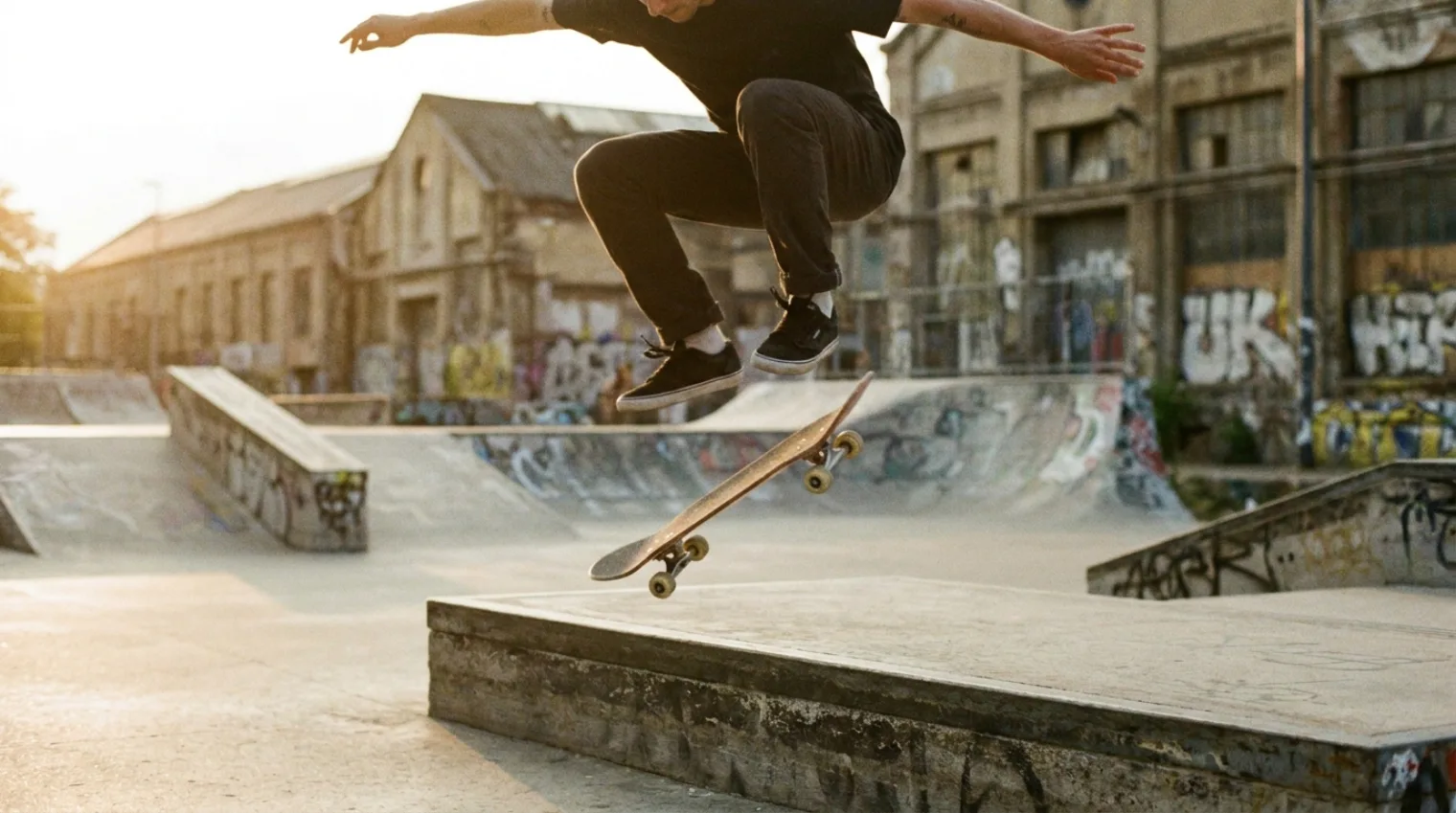
A varial kickflip takes two tricks you likely already have, pop shove-it and kickflip, and asks you to fire them at the same time instead of one after another. Onbolts rates it intermediate, with an estimated learning time of 2–6 months, and the skill tree lists pop shove-it and kickflip as its two prerequisites. If you've landed both of those consistently, you already own every individual motion the trick needs. The work left is purely in the timing.
What a varial kickflip is
A pop shove-it rotates the board 180 degrees under your feet, popped off the back foot, no flip involved. A kickflip flips the board along its long axis, scooped off the front foot, no rotation involved. A varial kickflip is both, simultaneously: the board spins flat and flips end over end at the same time, so it's rotating on two axes at once before your feet catch it.
That two-axes-at-once description is the whole reason this trick reads as intermediate rather than beginner, even though every motion inside it is one you've already drilled separately.
For a lot of skaters, varial kickflip is the first time a trick asks for two axes of rotation at once, and it's worth treating as practice for that broader skill rather than a one-off trick to check off. The physics of flip tricks breaks down why combining a flip axis and a rotation axis takes disproportionately longer than either alone, and varial kickflip is the clearest, shortest example of that principle on the whole tree.
The two motions you already know, running together
Your back foot does the pop shove-it job: pop and scoop to start the rotation. Your front foot does the kickflip job: drag up and off the edge to start the flip. The difference from doing them one after another is that both feet commit at essentially the same instant, and your eyes have to track a board that's now moving in two directions rather than one.
Most skaters who've already got solid pop shove-it and kickflip find the rotation part comes back almost immediately. What takes the 2 to 6 months is learning to spot the board mid-trick when it's both flipping and spinning, so your feet know where to land rather than guessing.
A useful mental model here: don't watch the graphics on the board, watch the silhouette. Because the board is moving on two axes, trying to track a specific griptape pattern or wheel color leads your eyes in circles. Locking onto the overall shape, flat versus flipped, tail versus nose, is what lets your feet find the catch in time.
Why the tree gates it behind both prerequisites
Onbolts locks varial kickflip behind pop shove-it and kickflip specifically, not just one or the other. That pairing isn't arbitrary: pop shove-it supplies the rotation your back foot needs, kickflip supplies the flip your front foot needs, and the node stays locked on your progress tracker until both sit at consistent or mastered. Skaters occasionally try to jump in with a shaky kickflip, and the flip half being unreliable is usually what turns a 2 month trick into a 6 month one.
How to know you're ready to start
The tree won't unlock varial kickflip's node until pop shove-it and kickflip both sit at consistent or better on your progress tracker, but consistent on the 5-level scale still leaves room for variance. A practical check worth applying: can you land both prerequisites on the first or second push at a spot, not just eventually after a warmup streak? If either one still needs several attempts to click, that inconsistency will show up inside varial kickflip as extra weeks of confusion about which half of the trick is failing.
Common timing mistakes
- Popping the shove-it rotation late, so the flip finishes before the board has rotated, and you catch a flipped board that's still facing the wrong way.
- Under-committing to the flip because your attention is split with tracking rotation, which leaves the board under-rotated on the flip axis.
- Catching too early, jumping to grab the board with your feet before it has fully completed both motions, a habit carried over from single-axis tricks where timing is more forgiving.
- Losing the pop shove-it's natural pop because all the focus goes into the flip, flattening out what should be a crisp scoop.
- Rushing the catch because the trick feels quick to complete, which cuts the rotation short by a few degrees even when the flip itself finished cleanly.
The fix for all five is largely the same: slow the trick down in practice, exaggerate the rotation, and give the board a beat longer in the air than a plain kickflip attempt would need.
Where it sits relative to kickflip and hardflip
Varial kickflip's 2–6 month window sits close to kickflip's own 1–6 months, which makes sense since it's built directly from kickflip's mechanics plus one more motion layered on. It's a meaningfully smaller jump than hardflip, which pairs a kickflip flip with a frontside shove-it rotation instead of a full pop shove-it and lands at 4–12 months. The hardflip breakdown is worth reading once varial kickflip feels comfortable, since the two tricks share a lineage but diverge in how much rotation they ask for. Tre flip, which extends the same pop shove-it rotation to a full 360 degrees rather than varial kickflip's 180, sits further out still at 6–18 months, making varial kickflip a useful middle step between kickflip and either of the two bigger combination tricks.
A realistic timeline on the 5-level scale
Given the 2–6 month estimate, expect the early weeks to feel like relearning kickflip from scratch, because your brain is processing two axes of motion instead of one. Most of that window is spent moving from learning to landed once. Once you get a single clean catch where both the flip and rotation finish together, consistent tends to arrive faster than the first landed attempt did, since your body has now found the shared timing window.
It's also common to plateau right at landed once for a few weeks, landing the trick occasionally at a favorite spot but losing it completely anywhere else. That's not regression, it's your body confirming the timing works before it generalizes to different run-ups and surfaces, and it usually resolves faster than the initial breakthrough did.
What landing it opens up
Varial kickflip 180 is the direct next step on the tree, adding a further rotation on top of the varial kickflip's motion. If your longer term goal is something like tre flip, which pairs kickflip with a full pop shove-it style rotation at a steeper angle, varial kickflip is useful groundwork, even though the tree doesn't list it as a direct tre flip prerequisite. The tre flip timeline post covers that trick's own prerequisites in detail if that's the next target.
Varial kickflip across stances
The tree also carries fakie, nollie, and switch versions of this trick. Fakie varial kickflip sits at intermediate, the same tier as the regular version, while nollie varial kickflip and switch varial kickflip both jump to advanced. None of the three has a published learning-time estimate yet, so don't treat a specific number you find elsewhere for those variants as tree data.
That jump from intermediate to advanced for the nollie and switch versions lines up with what the mechanics predict: nollie and switch stances are already less familiar to most skaters than fakie, since fakie at least keeps your regular foot placement, just rolling backward. Layering a two-axis trick on top of an already less familiar stance compounds the difficulty in a way that fakie, riding on a stance you already half-know, doesn't.
A training approach that matches the physics
- Re-drill pop shove-it and kickflip separately first, focusing specifically on pop timing and flip commitment rather than just landing them.
- Practice the two motions in slow motion together, walking pace, before adding any real speed or pop.
- Exaggerate the rotation slightly in early attempts. It's easier to dial back an over-rotated varial kickflip than to rescue an under-rotated one.
- Track your attempts on the progress tracker. Because this trick's difficulty comes from timing rather than raw athleticism, session count tends to matter more than any single breakthrough attempt.
- Film a few attempts every session and check which half finished first, the flip or the rotation. That single observation tells you which foot's motion to isolate again before your next set of tries.
Once the fundamentals click, browse more tutorials for varial kickflip, or head back to the full tricks list to see how it connects to everything else on the skill tree.
Frequently asked
- Do I need pop shove-it or 360 shove-it before varial kickflip?
- Just pop shove-it. Onbolts' skill tree lists pop shove-it and kickflip as the two prerequisites for varial kickflip, not the 360 shove-it or any of its bigger-spin relatives.
- How long does varial kickflip usually take if I already have a solid kickflip?
- Onbolts' learning data estimates 2 to 6 months overall. Skaters who already have a reliable kickflip and pop shove-it tend to land toward the lower end of that range, since the individual motions are already built and the remaining work is purely timing.
- Is varial kickflip the same as a bigspin?
- No. A bigspin is a 360 degree shove-it combined with a body rotation, with no board flip involved. Varial kickflip flips the board along the kickflip axis while it rotates, so the two tricks look superficially similar in the air but use different mechanics.
- What should I learn after varial kickflip?
- Onbolts' tree lists varial kickflip 180 as the direct next trick, adding further rotation. Many skaters also use varial kickflip as informal groundwork before tackling hardflip or tre flip, even though neither lists it as a formal prerequisite.
- Why does my board flip but not rotate, or rotate but not flip?
- This is the most common varial kickflip issue and it's a timing problem, not a strength problem. If the board flips without rotating, your back foot's shove-it pop is firing late or too soft. If it rotates without flipping, your front foot's kickflip scoop needs more commitment relative to the pop.
- Is varial kickflip harder than heelflip?
- Onbolts rates heelflip at 1–4 months and varial kickflip at 2–6 months, so varial kickflip is the longer estimated trick of the two. Heelflip is a single-axis trick like kickflip, while varial kickflip adds a second axis of rotation on top of a flip you already know.