blog-post // Aug 9, 2026
Switch Kickflip: The Trick That Proves You Are More Than a One-Stance Skater
Switch kickflip is Onbolts' only advanced-rated kickflip variant, at 4–12 months versus intermediate at 1–6 months regular. Here is what that gap means.
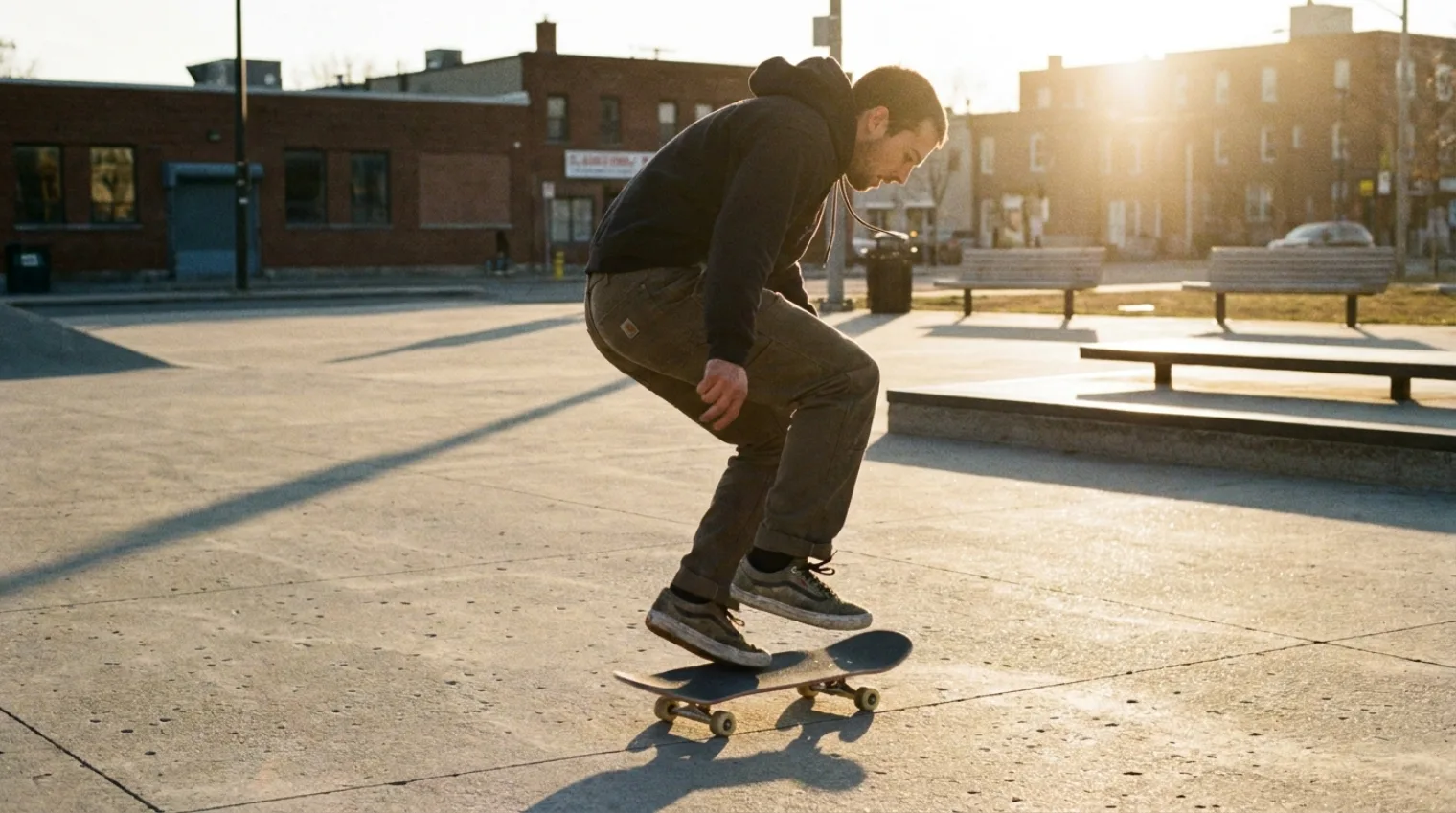
Switch kickflip is the same flick and rotation as a regular kickflip, performed entirely in your opposite stance. Onbolts' learning data rates it advanced at 4–12 months, the only kickflip variant on the platform rated advanced, against 1–6 months for the regular version. That single number is the clearest proof that switch is not a party trick, it is a real, separately-earned skill.
The kickflip family, side by side
Onbolts tracks four versions of the kickflip across the different stance variants, and lining them up tells a more honest story than any single description could.
Regular kickflip: intermediate, 1–6 months. Fakie kickflip: intermediate, 1–3 months. Nollie kickflip: intermediate, no specific time window logged yet. Switch kickflip: advanced, 4–12 months.
Three of the four sit at the same difficulty tier. Fakie kickflip is often faster than the original because the flick and stance stay unchanged, only your direction of travel and spatial sense reverse. Nollie kickflip changes which end of the board pops but keeps your stance and direction the same. Switch kickflip is the outlier on every axis: the only one rated a full tier higher, and by a wide margin the longest window of the four.
Why switch is fundamentally different from fakie and nollie here
The reason is not the flick itself, the actual foot motion that flips the board is close to identical across all four versions. The reason is what switch demands underneath the flick. Fakie keeps your stance untouched, you are riding backward but your feet never move from their normal spots. Nollie keeps your stance and direction untouched, only the pop point changes. Switch changes your entire stance: which foot is forward, which foot carries your weight by default, which side your body naturally rotates toward.
That means switch kickflip is not one new skill layered on an old one, the way fakie kickflip mostly is. It is closer to relearning the kickflip from scratch, using a stance that has a fraction of the reps your dominant stance has behind it. Onbolts' 4–12 month window reflects that rather than assuming the trick should take roughly the same time because the flick pattern is familiar.
What you need before attempting it
The Onbolts skill tree lists two prerequisites for switch kickflip: a landed kickflip in your regular stance, and a solid switch ollie. Both are load-bearing. Skaters sometimes assume that because they already own the kickflip motion, the switch version should come quickly once switch ollie is down. That is not what the data shows. A switch kickflip attempted before switch ollie is consistent, not just landed a handful of times, tends to drag out well past the upper end of the 4–12 month window, because balance problems and flick problems get debugged at the same time instead of separately.
Get switch ollie to the point where you are not thinking about your feet anymore. That is the real gate here, more than the kickflip motion itself.
Why the wide range (4 to 12 months) makes sense
A 1–6 month window for a regular kickflip already reflects real variation between skaters. Switch kickflip's 4–12 month window is wider still, and that is not noise in the data, it reflects how much more switch progress varies from person to person. Some skaters have a naturally quick sense of balance in their opposite stance and close most of the gap in a few months of dedicated practice. Others need considerably longer, not because they are doing anything wrong, but because switch balance develops at different rates than dominant-stance balance does, and there is less established shared technique around closing that gap fast.
Treat the low end of that range as a best case, not an expectation, and do not read a slower timeline as a sign you are behind. The data already assumes wide variation.
What comes after switch kickflip
Once switch kickflip is landing consistently, the Onbolts skill tree opens two tricks directly: switch heelflip and switch tre flip, the latter also requiring switch shove-it as a second prerequisite. Switch hardflip builds further on top of switch kickflip, adding a switch frontside shove-it into the mix. All three represent a real jump past switch kickflip rather than a quick follow-up, so treat switch kickflip as a milestone worth sitting with, not a stepping stone to rush past.
The varial branch runs through switch kickflip too
Switch kickflip is not only a gateway to switch heelflip, switch tre flip, and switch hardflip. Switch varial kickflip also lists switch shove-it and switch kickflip as its two prerequisites, the exact same combination switch tre flip requires, just paired with a different flick outcome. That means once switch shove-it and switch kickflip are both consistent, two separate advanced tricks become realistic at the same time rather than one unlocking the other in sequence. Skaters who log both attempts on their progress page often notice one clicks faster than the other even though the prerequisites are identical, which is normal, the added rotation in tre flip and the added shove-catch in varial kickflip stress slightly different parts of your switch balance.
How to structure practice around a multi-month trick
A trick with a 4–12 month window rewards a different practice rhythm than a trick you expect to land in a few sessions. Rather than judging each session by whether you landed it, track smaller signals: are your setup and pop becoming automatic, is your board control mid-flip improving, are you catching more consistently even if you are not riding away yet. Logging switch kickflip attempts on your progress page using the same 5-level scale as everything else, learning through to consistent and mastered, gives you an honest record of that slower kind of progress instead of relying on memory, which tends to remember the plateaus more than the gains.
Common mistakes chasing switch kickflip
Skipping straight to it because the regular kickflip feels easy now. Familiarity with the flick does not transfer the balance and timing switch requires. Confirm switch ollie is solid first.
Practicing it only occasionally, as a novelty. Switch skills, more than most, decay between sessions if they are not given dedicated, repeated time. A once-a-week attempt rarely adds up to steady progress on a trick with a multi-month window.
Getting discouraged by the range. A 4–12 month spread means slower progress within that window is still on pace, not falling behind. Comparing your specific timeline against the fastest end of the range, rather than the range as a whole, is a reliable way to feel behind when you are not.
Why this trick is worth it
Switch kickflip is not on the tree because it looks impressive in a clip, though it does. It is there because it is the clearest test of whether your switch stance is developed, not just passable for a shove-it or an ollie. A skater who owns switch kickflip has built real balance, timing, and flick control on their weaker side, not just picked up a party trick. That is a meaningfully different, and more durable, skill than most switch tricks people chase for the clip alone.
What this trick says about your skating overall
A trick list built entirely on your dominant stance can look substantial while still leaving a real gap in how you skate. Switch kickflip is a useful check on that, because there is no shortcut through it: you cannot fake the balance, and you cannot borrow reps from your regular stance to speed it up. Skaters who put in the months for switch kickflip tend to report their whole switch game improving alongside it, switch ollie gets more solid, switch shove-it gets more comfortable, simply because the extended practice window forces more total switch riding time than any single trick would otherwise demand.
The takeaway
Switch kickflip is the same kickflip you already know, run through a stance with a fraction of the reps your dominant side has. Onbolts' data makes the cost explicit: advanced difficulty, 4–12 months, the only kickflip variant rated a full tier above the other three. That gap is not a flaw in the trick or in you, it is what switch costs, measured plainly.
Get switch ollie solid first, track both it and switch kickflip separately on your progress page, and once switch kickflip lands, check the skill tree for switch heelflip and switch tre flip as your next steps. Browse the full tricks list to see every switch variant Onbolts tracks along the way.
Frequently asked
- What makes switch kickflip different from a regular kickflip?
- The flick and rotation are the same trick, but switch kickflip is performed entirely in your opposite stance, not just a reversed direction of travel like fakie, and not just a different pop point like nollie. Onbolts rates it advanced at 4–12 months, a full tier and several months above the 1–6 months for a regular kickflip.
- Why is switch kickflip rated advanced while fakie and nollie kickflip are rated intermediate?
- Across every kickflip variant Onbolts tracks, switch kickflip is the only one rated advanced. Fakie kickflip keeps your stance and flick mechanics unchanged, and nollie kickflip changes only which end pops. Switch kickflip changes your entire stance, meaning your balance, timing, and flick all have to be rebuilt from a much smaller base of reps than your dominant side has.
- What do I need before attempting a switch kickflip?
- Onbolts' skill tree lists two prerequisites: a landed regular kickflip and a solid switch ollie. Both matter. A shaky switch ollie means you are fighting balance and the flick at the same time, and a shaky kickflip on your dominant side means you do not yet have a reliable pattern to translate over.
- How long does switch kickflip take?
- Onbolts' learning data puts it at 4–12 months for skaters who already have both prerequisites solid, compared to 1–6 months for a regular kickflip. The window is wide because switch progress varies more between skaters than dominant-stance progress does, some pick up switch balance quickly, others need considerably longer.
- What comes after switch kickflip?
- Onbolts' skill tree opens two direct tricks from switch kickflip: switch heelflip and switch tre flip, the latter also requiring switch shove-it. Switch hardflip builds on top of switch kickflip as well, combining it with a switch frontside shove-it.
- Is switch kickflip worth the time investment?
- If the goal is a well-rounded switch stance rather than just one impressive clip, yes. It is the clearest single data point Onbolts has for how much switch skating costs versus how it looks: the only kickflip variant rated a full difficulty tier higher than the rest, with the longest learning window of the four.